Nonword Reading Deficit In Developmental Dyslexia
Nonword reading deficit in developmental dyslexia TTn a recent narrative review Rack Snowhng and Aoison 1992 concluded that strong evidence exists for the phonological deficit hypothesis in explamjng severe word reading and spellmg problems that cannot be. The finding that RE has an unusual difficulty in reading and spelling nonwords provides evidence that she must have a deficit in the ability to store and recall phonemes Butterworth Campbell 1985.
 Pdf The Nonword Reading Deficit In Developmental Dyslexia Evidence From Children Learning To Read German Semantic Scholar
Temple 1984 Temple 1997.

Nonword reading deficit in developmental dyslexia. The Nonword Reading Deficit in Developmental Dyslexia. A dyslexic child was assigned to the DDN group where N indicates poor nonword reading if her Z score for nonword reading accuracy was below 15 SDs on the standardized list of nonwords. The nonword reading deficit in developmental dyslexia.
Reading disorder or developmental dyslexia is defined by achievement of reading skills that are considerably lower than would be expected from the profile of measured abilities in other cognitive domains when neurological and sensory function is normal and other socio-cultural factors including access to education are at least adequate. This form of developmental dyslexia has also been documented in numerous studies Temple and Marshall 1983. Reading Research Quarterly v29 n3 p266-75 Jul-Sep 1994 Evaluates the hypothesis that dyslexic children have a specific deficit in phonological reading processes.
The results suggest that developmental dyslexia at the age of 12 might be or might have become a difficulty rather isolated from deficiencies in other cognitive and motor skills. The Nonword Reading Deficit in Developmental Dyslexia. As in the study of Facoetti et al.
The same group of dyslexics show that phonological In recent years however the phonological deficit deficits outweigh visual auditory and motor deficits. Evaluates the hypothesis that dyslexic children have a specific deficit in phonological reading processes to elucidate the characteristics of developmental dyslexics reading skills. Download to read the full article text.
All dyslexic children who did not meet the criterion for inclusion in the DDN group were assigned to the DDN group where N indicates near-normal nonword reading. Describes a quantitative meta-analysis with the same hypothesis that provides evidence for differences between dyslexics and normal readers on nonword reading tasks. Snowling et al 1986.
Dyslexia was not associated with deficits in other areas. Finds no evidence for distinct subtypes of dyslexia although recent conceptualizations of reading development provide a better framework in which to investigate individual differences. Many other individual case studies and group studies have also found evidence to support the phonological theory of dyslexia.
Nonword reading deficit which is characteristic of dyslexic children learning to read English Rack Olson Snowling 1992 a deficit which is taken as evidence for a phonological impairment underlying dyslexia. For nonword reading our measure of decoding middle panel the deficits observed in the groups with dyslexia and dyslexia DLD are large at both time points and do not differ. Most of the poorest readers nearly all of whom qualified as dyslexic had a double or triple deficit in phonological naming-speed and orthographic skills.
Conclusions were that dyslexia results from an overload of deficits in skills related to reading for which the child cannot easily compensate. A difficulty in acquiring the nonlexical procedure is known as developmental phonological dyslexia and is indicated by abnormally poor performance on nonword reading. First predictions from developmental models and longitudinal data on reading development are.
Campbell and Butterworth 1985. 101002dys324 Meta-analysis of the Nonword Reading Deficit in Specific Reading Disorder. Some research on developmental dyslexia focuses on linguistic abnormalities such as poor reading of nonwords or poor reading of exception words.
CiteSeerX - Document Details Isaac Councill Lee Giles Pradeep Teregowda. A review D yslexia is typically defined as a reading and spell- ing problem that cannot be accounted for by. Title THE NONWORD READING DEFICIT IN DEVELOPMENTAL DYSLEXIA - A REVIEW abstract TO ELUCIDATE the characteristics of developmental dyslexics reading skills the authors evaluate the hypothesis that dyslexic children have a specific deficit in phonological reading processes.
To contribute to developmental dyslexia across languages therefore beat detection should be related to spelling as well as to readingOn the basis of the prior basic auditory processing literature with dyslexic children we also included two rapid temporalprocessing tasks in our study. The causes of developmental orthographic impairments in dyslexia would be a con- dyslexia are probably multifactorial Pennington 2006 sequence of underlying deficits in phonology and or yet studies comparing different classes of deficits within deficits in mapping visual onto phonological codes. The group with DLD also has significant deficits relative to controls but they are much less seriously affected than the other two groups.
This nonword reading deficit was observed for nonwords with little similarity to existing German words as well as for nonwords which were analogous to short frequent content words. TO ELUCIDATE the characteristics of developmental dyslexics reading skills the authors evaluate the hypothesis that dyslexic children have a specific deficit in phonological reading processes. It is hypothesized that dyslexic children learning German do not differ from dyslexic children learning English in their underlying phonological impairment but that they do differ with respect to the expression of.
First predictions from developmental models and longitudinal data on reading development are established.
 Breakdown Of Errors On The Wepman Test And Nonword Reading Scores For Download Scientific Diagram
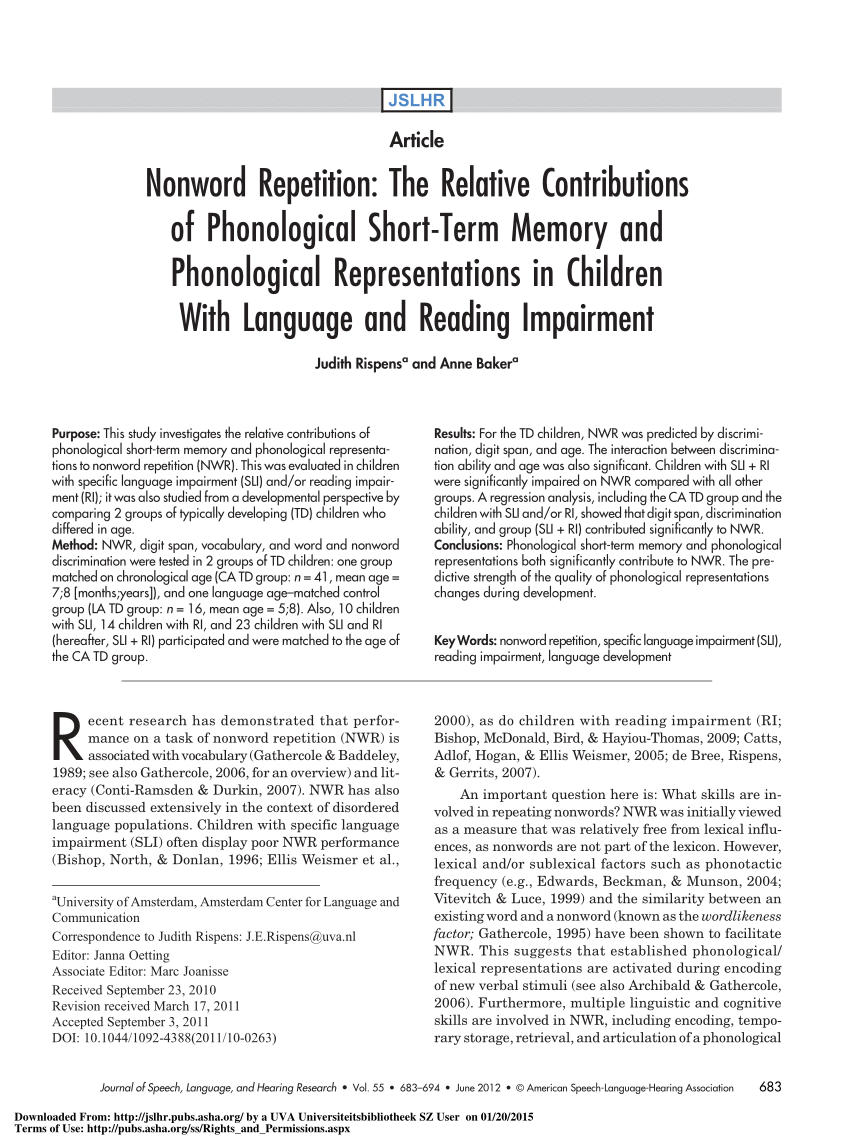 Pdf Nonword Repetition The Relative Contributions Of Phonological Short Term Memory And Phonological Representations In Children With Language And Reading Impairment
 Diagnostic Accuracy Of Sentence Repetition And Nonword Repetition For Developmental Language Disorder In Vietnamese Journal Of Speech Language And Hearing Research
 Lists Of Word And Non Word Stimuli Used In The Study Download Scientific Diagram
 Breakdown Of Errors On The Wepman Test And Nonword Reading Scores For Download Scientific Diagram
 The Nonword Decoding Test Dyslexia Tests The Nonword Decoding Test Nonword Decoding Test Raw Score Reading Age From To 0 6 5 1 Ferguson S Delta See
 Pdf Order Short Term Memory Capacity Predicts Nonword Reading And Spelling In First And Second Grade
 Pdf The Nonword Reading Deficit In Developmental Dyslexia A Review
 Length Effects In Reading Words And Nonwords For Different Groups Of Download Table
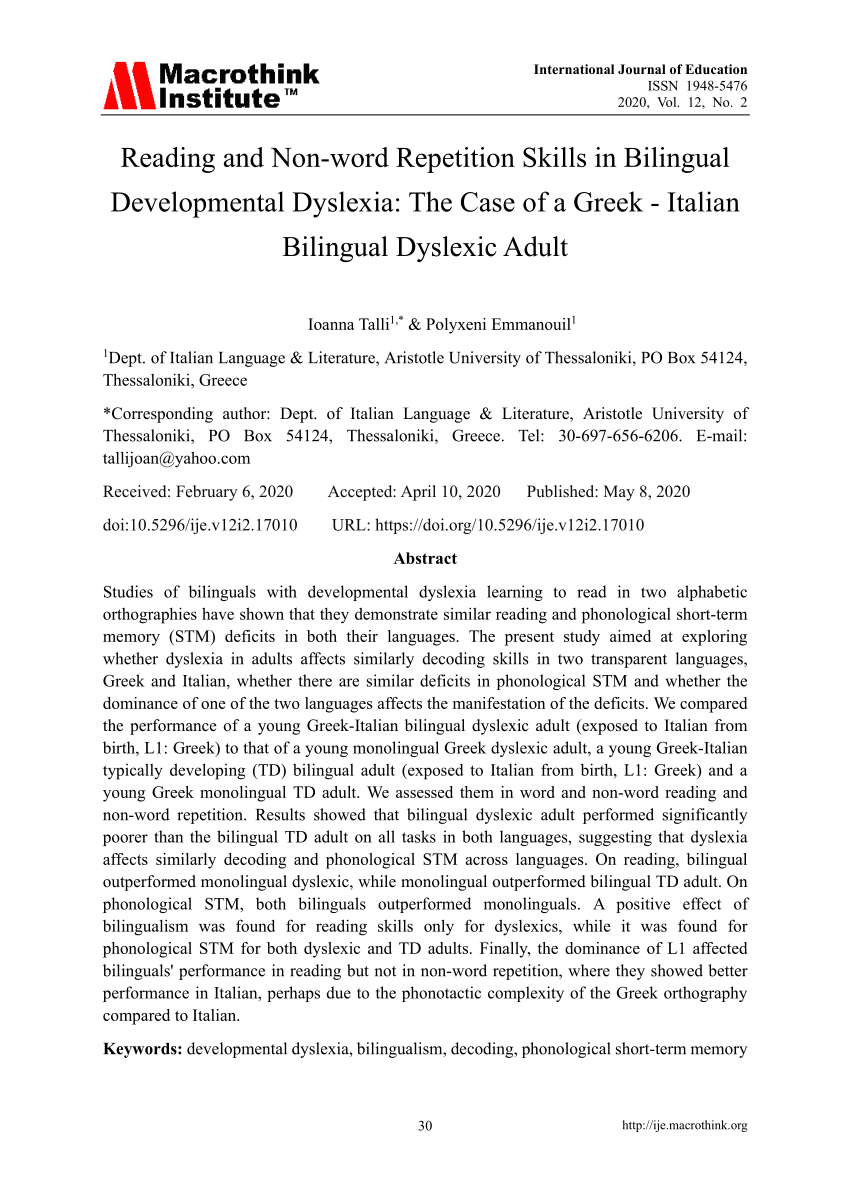 Pdf Reading And Non Word Repetition Skills In Bilingual Developmental Dyslexia The Case Of A Greek Italian Bilingual Dyslexic Adult
 Nonword Repetition And Vocabulary Knowledge As Predictors Of Children S Phonological And Semantic Word Learning Speech Language Therapy Vocabulary Language Therapy
 Nonword Repetition Accuracy For Low Lexicality Nonwords For The Td Download Scientific Diagram
Examples Word Errors Nonword Errors Spelling Errors English Download Table
 Modeling And Visualizing The Codevelopment Of Word And Nonword Reading In Children From First Through Fourth Grade Informing Developmental Trajectories Of Children With Dyslexia Steacy Child Development Wiley Online Library
 Measures Of Word And Nonword Reading Accuracy And Speed And Spelling Download Table
Http Www Iapsych Com Articles Herrmann2006 Pdf
 Pdf The Nonword Reading Deficit In Developmental Dyslexia A Review
 Pdf How Does Phonological Awareness Relate To Nonword Reading Skill Amongst Poor Readers
 Individual Results On The Speech Discrimination And Nonword Repetition Download Table